Janice Tayler · Abstract Painter · Currently at JG Art Gallery
Janice Tayler was born in Winnipeg, Manitoba in 1963. She received her BA with Honours in Theatre and Dance from the University of Winnipeg in 1990, then moved to Montreal and danced professionally from 1993 to 2000. An injury ended that career, and she picked up a paintbrush. Seeing the work of Francis Bacon was decisive — it set her toward abstraction and she has not left. She completed her BFA with Distinction in Painting and Drawing from Concordia University, Montreal in 2004, and has exhibited across Canada, the United States, and Europe since. She now lives and works in Olalla, Washington, on the Kitsap Peninsula.
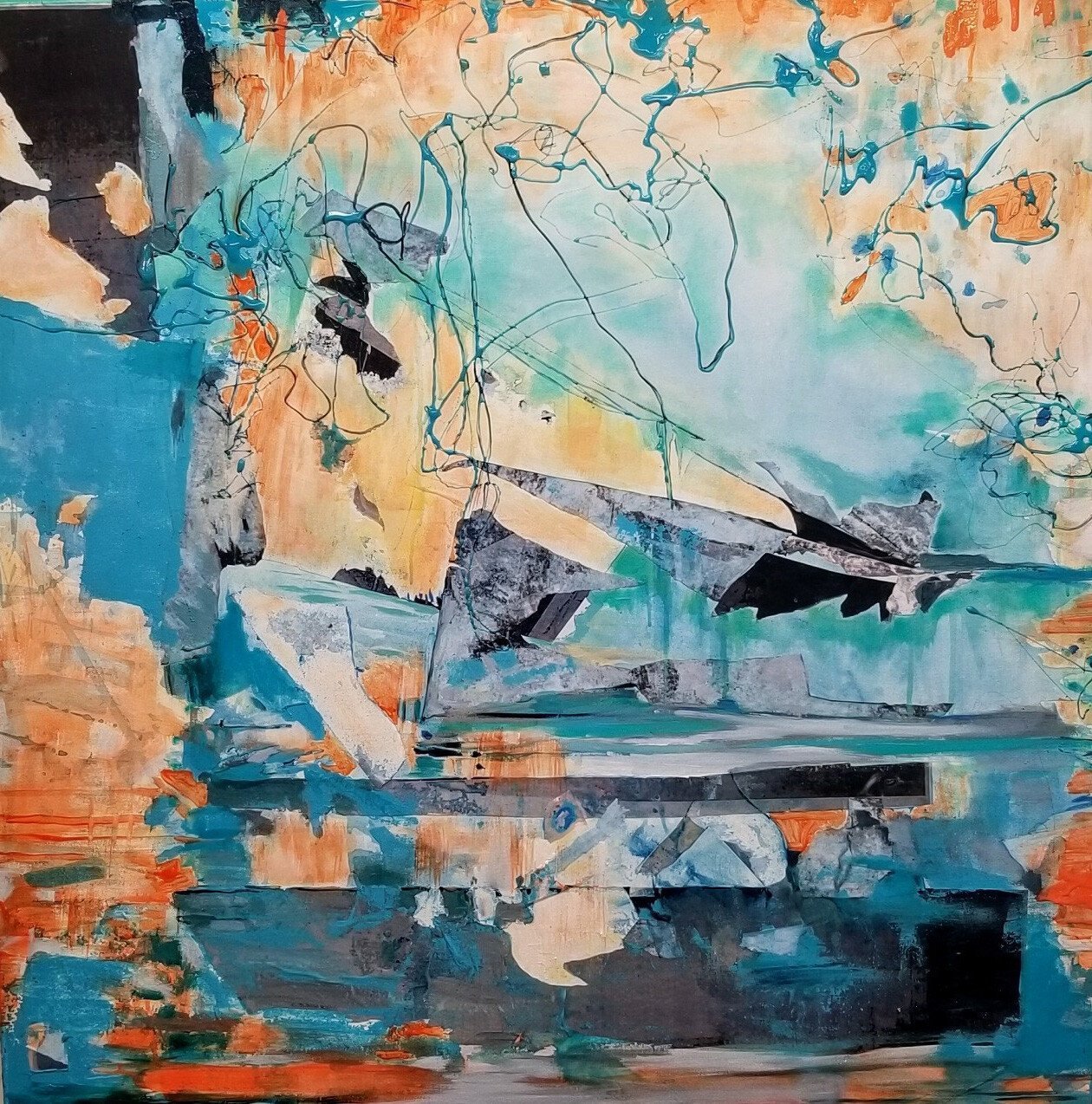
Her medium is oil paint, newspaper collage, and sand on canvas — a combination she works in layers, scraping back and adding, building a surface that holds the texture and weight of the accumulated decisions. The source material is photographs and drawings of demolished structures: partially completed bridges, abandoned industrial sites, decaying buildings, urban devastation. These she sets against abstracted organic forms — roots, rocks, trees, water — loosely positioned according to the spatial logic of classical landscape painting. In Tracing The Winged Energy of Delight, The composition orchestrates a horizontal tension between turbulent turquoise passages and burnt orange accretions, with blacks and grays cutting diagonally across the field like jagged horizons. Layered newspaper fragments and sand create tactile friction against fluid oil washes, their matte surfaces interrupting the paint's reflective capacity and anchoring the work's upper registers with material weight. The artist positions a network of gestural blue-black lines as active agents that move across rather than within the chromatic zones—a spatial strategy that keeps viewer attention perpetually unsettled between surface incident and illusionistic depth. In Under Dipped Currents, Tayler layers cerulean and prussian blue horizontally across the upper register while rust-orange and ochre fragments congregate in the lower half, creating a chromatic inversion that the embedded newspaper—with its visible grid and text—interrupts with competing linear systems. The sand particles catch paint's viscosity unevenly, producing a crust-like surface where oil pooled differently than expected, while collaged elements curl and cast shadows that contradict the flatness of the canvas itself. The composition bifurcates vertically into two spatial registers that refuse to reconcile, yet the painting's apparent disorder actually reveals a systematic investigation into how materials resist unified pictorial space. In Threaded Remnants, Janice Tayler constructs a densely layered composition where burnt orange and cadmium red paper strips slash across teal and deep ultramarine grounds, their torn edges creating sharp interruptions that prevent any restful reading of the surface. Sand particles embedded throughout roughen the picture plane into tactile peaks and valleys, while newspaper fragments peek through as pale geometric counterpoints that ground the chromatic turbulence. The work's critical weakness lies in its reliance on gestural chaos—the overlapping strokes and collage elements compete for attention rather than achieving a coherent spatial hierarchy, leaving the eye without a clear pathway through the composition.
The Abstract Expressionists of New York and Anselm Kiefer — specifically his monumental textured surfaces — run through her visual thinking. Dance never left: the gestural vocabulary she developed through ballet training, performance, and choreography translates directly into how she moves paint. She is a member of the Women Painters of Washington, Puget Sound Group of Northwest Painters, and Peninsula Art League. She has taught painting, drawing, and mixed media workshops across the United States and Canada since 2005, and gave slide presentations on the history of modern art and modern dance at McGill University in 2008–09. Her work was included in a Spotlight Exhibition at the Bainbridge Island Museum of Art in 2023.
My abstract paintings attempt to navigate the space between serenity and instability. I maintain that only through abstraction can the viewer tap into their unconscious and access the sublime in their imagination. The process is analogous to our own lived layers and complexities.
Janice's practice, in detail.
Education & Formation
- 1963Born — Winnipeg, Manitoba, Canada
- 1990BA Honours, Theatre and Dance — University of Winnipeg
- 1993–2000Professional dancer — Montreal, QCBallet and modern dance, choreography
- 2004BFA With Distinction, Painting and Drawing — Concordia UniversityMontreal, QC. Francis Bacon discovery → abstraction
- 2008–09Slide presentations — McGill UniversityHistory of Modern Art · History of Modern Dance
- 2005–Teacher of painting, drawing and mixed media workshopsUSA and Canada
Solo Exhibitions
- 2024"Wading Through Cracks In Gravity" — 1515 Lincoln GalleryOklahoma City, OK
- 2023"Mavi Contemporary Art" solo — Gig Harbor, WA
- 2022"Layered Suspensions In Fragmented Space" — Objets TrouvésOklahoma City, OK
- 2017"Blueprints For A Splintered Sun" — Morso GalleryGig Harbor, WA
- 2013"New Works" — Gallery Lacosse, Winnipeg, MB
- 2012"Articulated Fragments" — Warehouse Artworks, Winnipeg, MB
- 2004"Gestures of Fragmental Shifting" — Zeke's Gallery, Montreal, QC
Selected Group & Awards
- 2025"Fractured Forms" — Woodward Contemporary, San Diego, CA
- 2025"Open to Interpretation" — JG Art Gallery, Bainbridge Island
- 2023Spotlight Exhibition — Bainbridge Island Museum of Art
- 2017Prince Street Gallery — New York City, NY
- 20153rd place, Daniel Smith Award — juried group painting show, Seattle, WA
- 2009Travel Scholarship — The Artists Project, Toronto, ON
- 2001Millennium Scholarship Fund — Concordia University
Current Representation
- GalleryRyan James Fine Art Gallery — Kirkland, WA
- Gallery1515 Lincoln Gallery — Oklahoma City, OK
- GalleryWarehouse Artworks — Winnipeg, MB, Canada
- GalleryJG Art Gallery — Bainbridge Island & Park City
- CollectionsPrivate and commercial collections — United States, Canada, Europe
Memberships
- MemberWomen Painters of Washington
- MemberPuget Sound Group of Northwest Painters
- MemberPeninsula Art League — Gig Harbor, WA
- AnnualGig Harbor Open Studio Tour — Olalla, WA2023, 2024, 2025
Practice
- MediumOil paint, newspaper collage, sand on canvasCharcoal, varnish, image skin transfer also used
- SourcePhotographs of demolished structures — bridges, industrial sites, decaying buildingsJuxtaposed with abstracted rocks, roots, trees, water
- InfluencesFrancis Bacon · NY Abstract Expressionists · Anselm KieferDance gestural vocabulary — 20 years of professional movement
As featured in.
Selected works.
A current selection from Janice's work, available through JG Art Gallery. The gallery responds within one business day with placement, dimensions, and indicated price for the work in question.
The gallery responds within one business day.
For current availability, pricing, or to commission new work, write directly. Worldwide shipping, payment plans, full provenance documentation.