Siddharth Parasnis · Painter · Currently at JG Art Gallery
“Painting takes the viewer with me on a journey to share that which may be derived directly from life or memory, imagination, or dreams.”
Selected works.
A current selection from Siddharth's work, available through JG Art Gallery. The gallery responds within one business day with placement, dimensions, and indicated price for the work in question.
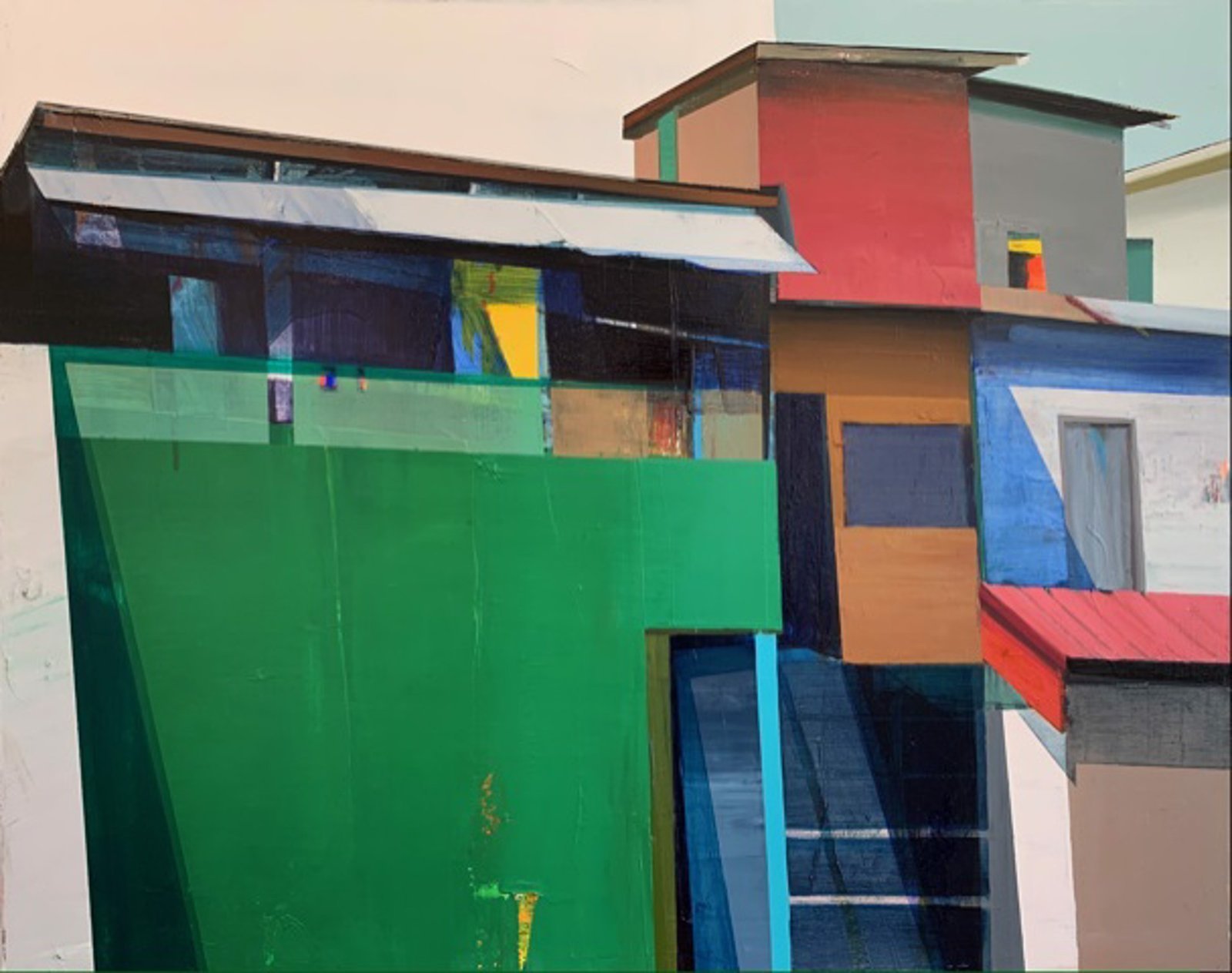
Siddharth Parasnis was born in India in 1977 and grew up in the orbit of two cities whose density and visual energy have never left his painting: first Bombay, where he earned a BFA in Illustration and Advertising from the Directorate of Art, and then San Francisco, where he arrived in 2001 to pursue an MFA in Painting at the Academy of Art University and has lived and worked ever since. He calls his paintings architectural abstractions — a term that describes both the subject and the method. He photographs and sketches buildings on his travels — in India, Guatemala, Costa Rica, Honduras, California — not to document them but to extract the color relationships and spatial pressures encoded in their surfaces. Back in the studio, he translates these photographs onto panel in glazed oil, abstracting until shape and color take over from recognition.
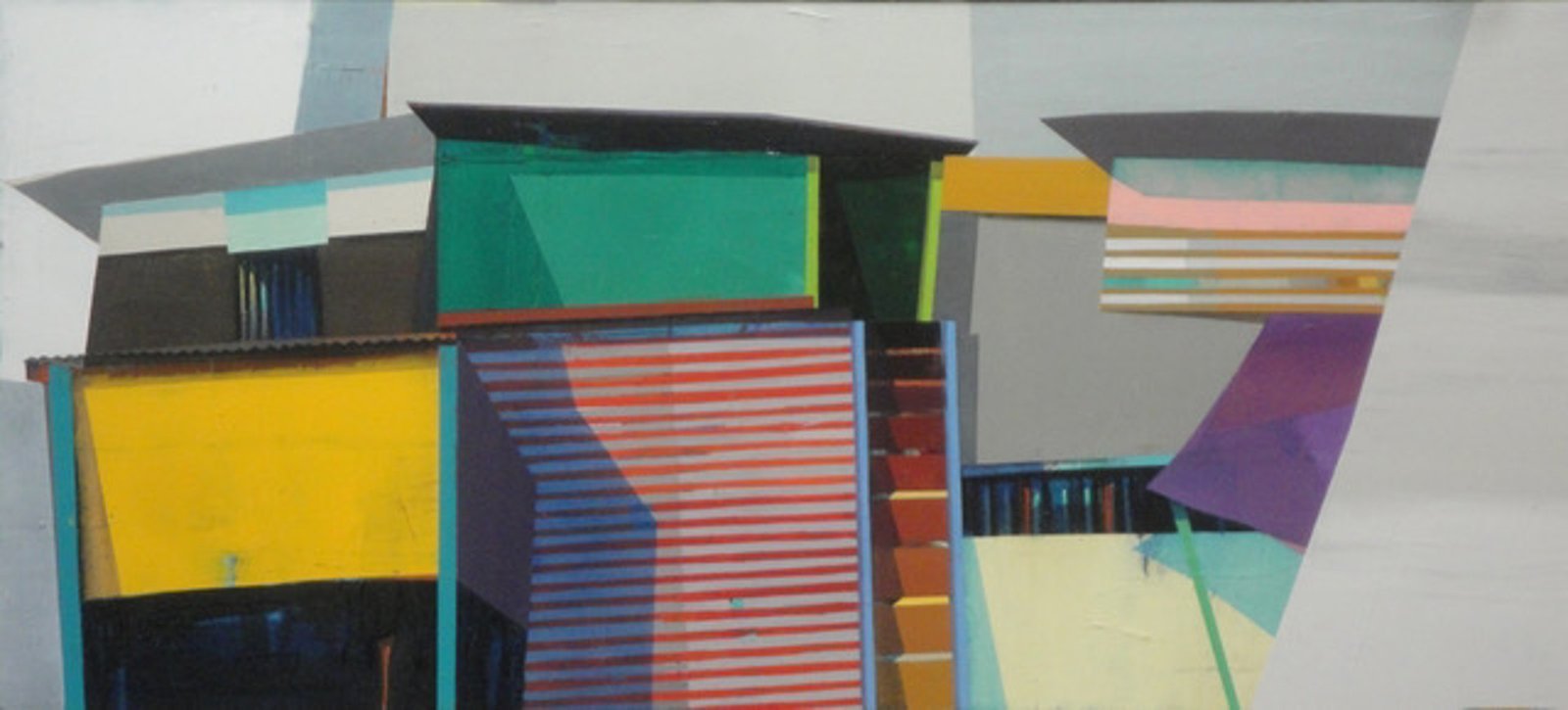
In Eternity, parasnis layers chartreuse, cadmium yellow, deep teal, and rust-red across a fragmented architectural form, with each color occupying distinct planar zones that refuse to cohere into unified space. The paint sits flatly on the surface, applied in hard-edged sections and linear striations that emphasize the canvas as object rather than window, while angular cantilevers and receding planes stack upward in a compressed, claustrophobic composition. The work's ambition to contain infinity through geometric structure ultimately produces visual cacophony—a contradiction between the title's promise of transcendence and the painting's stubborn material insistence on rupture and discontinuity. His process is built around the concept of the single session — each painting captured whole in one sitting, which he describes as capturing the soul of the painting, giving it life or birth. He builds surfaces in saturated glazes, playing gloss and matte finishes against each other to push certain elements forward and pull others back, the whole composition held in balance between likeness and abstraction. His influences span three centuries: Hopper’s architectural specificity, de Kooning’s gestural freedom, Diebenkorn’s color logic, Oliveira’s surface weight, and the pre-modern Indian miniature tradition in which depth is conveyed through stacked imagery rather than perspectival recession. As curator Dieter Tremp has written, his paintings are “full of independent life, in a balance of sensuality and structure unlike anything else we’ve seen so far.”
He was awarded the Pollock-Krasner Foundation Grant for 2012–13. He was selected for the De Young Open in 2020 and again in 2023. His museum exhibitions include the Crocker Art Museum in Sacramento, the Triton Museum of Art, and the Bakersfield Museum of Art — where his work was shown alongside Diebenkorn, Oliveira, Elmer Bischoff, Joan Brown, and Theophilus Brown. His work is held at the Priscilla and Mark Zuckerberg San Francisco General Hospital and Trauma Center, Stanford Medical Center, the Galesburg Civic Art Center, and the South Central Zone Cultural Center in Nagpur, India. He has been reviewed in the Huffington Post, American Art Collector, Southwest Art Magazine, and Art Ltd.
Painting takes the viewer with me on a journey to share that which may be derived directly from life or memory, imagination, or dreams. I think my colors come from my conscious and subconscious experiences, and from the life that I have witnessed so far in India and here in the United States. While painting, it all comes out — colors find the right places for themselves in the painting. I have to react to the canvas spontaneously.
Siddharth's practice, in detail.
Education
- MFAAcademy of Art UniversityPainting — San Francisco, CA — arrived 2001
- BFADirectorate of ArtIllustration and Advertising — Bombay, India
- BornIndia, 1977Grew up in Bombay · lives and works San Francisco since 2001
Selected Solo Exhibitions
- 2022Intangible Realities — Caldwell Snyder GallerySan Francisco, CA
- 2021Utopia — Caldwell Snyder GallerySan Francisco, CA
- 2019Hues and Harmony — Caldwell Snyder GallerySan Francisco, CA
- 2018Serendipity — Caldwell Snyder GallerySan Francisco, CA
- 2017Discovering Color — Caldwell Snyder GallerySan Francisco, CA
- 2015Solitude — Campton GalleryNew York, NY
- 2014Ambiance, Not Identity — Caldwell Snyder GallerySan Francisco, CA
- 2012Wanderlust — Dolby Chadwick GallerySan Francisco, CA
Museum & Juried Exhibitions
- 2023De Young Open 2023The de Young Museum, San Francisco, CA
- 2020De Young Open 2020The de Young Museum, San Francisco, CA
- 201778th Crocker Kingsley ExhibitionCrocker Art Museum, Sacramento, CA
- 2016Salon at TritonTriton Museum of Art, Santa Clara, CA
- 2014Recent Works — Bakersfield Museum of ArtWith Diebenkorn, Oliveira, Bischoff, Joan Brown, Theophilus Brown
- 2012Legacy in Continuum: Bay Area FigurationBakersfield Museum of Art
- 2008Expressions West 2008Coos Art Museum, Coos Bay, OR
- 200574th Crocker Kingsley ExhibitionCrocker Art Museum, Sacramento, CA
Press & Recognition
- 2012–13Pollock-Krasner Foundation GrantMajor US arts grant
- 2016–17Artist in Residence — STAR Shipyard Trust for the Arts
- 2012Huffington Post — John SeedCritical interview
- 2010American Art Collector — Joshua Rose
- 2009American Art Collector · Southwest Art · Art Ltd. · Orange Coast
- CriticalDieter Tremp (curator)“Full of independent life, in a balance of sensuality and structure unlike anything else we’ve seen so far.”
Public Collections
- San FranciscoPriscilla and Mark Zuckerberg SF General Hospital and Trauma Center
- Palo AltoStanford Medical Center
- IllinoisGalesburg Civic Art Center
- IndiaSouth Central Zone Cultural CenterNagpur, India
- CaliforniaBakersfield Museum of Art
Practice & Works at JG
- ProcessSingle-session glazing on panelEach painting captured whole in one sitting — the soul of the painting
- InfluencesHopper · de Kooning · Diebenkorn · Oliveira · RothkoIndian miniature painting tradition — depth through stacked imagery
- JG WorksEternity #102 · Eternity #121Oil on panel — available now
As featured in.
The gallery responds within one business day.
For current availability, pricing, or to commission new work, write directly. Worldwide shipping, payment plans, full provenance documentation.